- 3
- Product iterations shipped
- 2.5 yrs
- Prototype to deployment
Stack
The problem
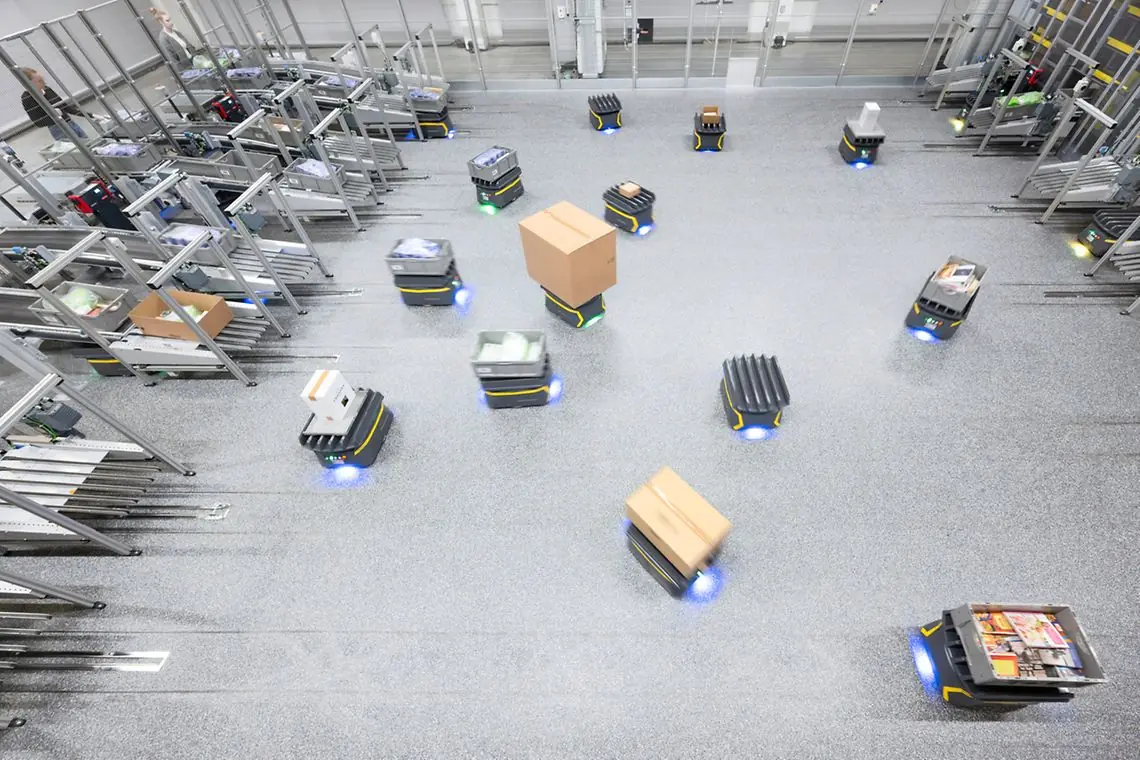
The Fastbots system at DS Automotion was developed with the ambitious goal of replacing traditional intralogistics methods such as conveyor technology. The vision was that a swarm of robots would replace fixed conveyor systems for moving items in warehouses, from the shelves to the packing area. The moment a swarm comes into play, quite a few problems have to be solved. How do you coordinate activities between the robots? How do you localize them? How do you avoid collisions? How do you plan and replan motion efficiently?
My role
I was the sole software engineer given the hardware platform, and I set to work building the brain of the robots. This meant writing drivers for the motors, battery, localization system and path planning system. Most of that was second nature to me, given how many hardware modules I had worked with by then. What was genuinely novel in these robots was the localization system and the planning module.
Approach
Instead of classical particle-filter-based localization, we decided to use a novel image-based sensor that photographs the floor and localizes from slight variations in the image. The sensor was an early-production product from Accerion, a company based in the Netherlands. I integrated the Accerion sensor into our robot, improving their SDK and fixing several bugs in their core software in the process. That required working closely with the vendor and testing their hardware and software on our robots.
Another challenge was to enable dynamic planning and replanning. The planning module was developed by RISC Software and based on time-window scheduling for the trajectories. Each robot was given a schedule to occupy a time window, and the control software had to make sure those windows were not violated. I built time-window tracking into the control software so that the controller could check for violations and report them.
Outcome
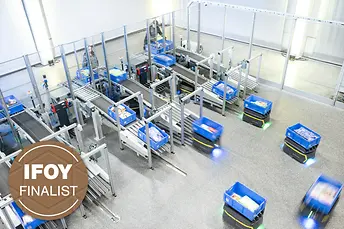
The platform kept going after I left. In January 2026 the FastBots Solution was nominated for the IFOY Award 2026 in the Robot Warehouse System category - a fleet of networked mobile transport robots under centralised fleet control, which is the system those first three iterations were converging towards. Today the system is a full-fledged product that has been tested in a range of warehouses.