Underwater Robot Swarms
One design paradigm for collective behaviour - formalised in a PhD, validated in the Venice lagoon
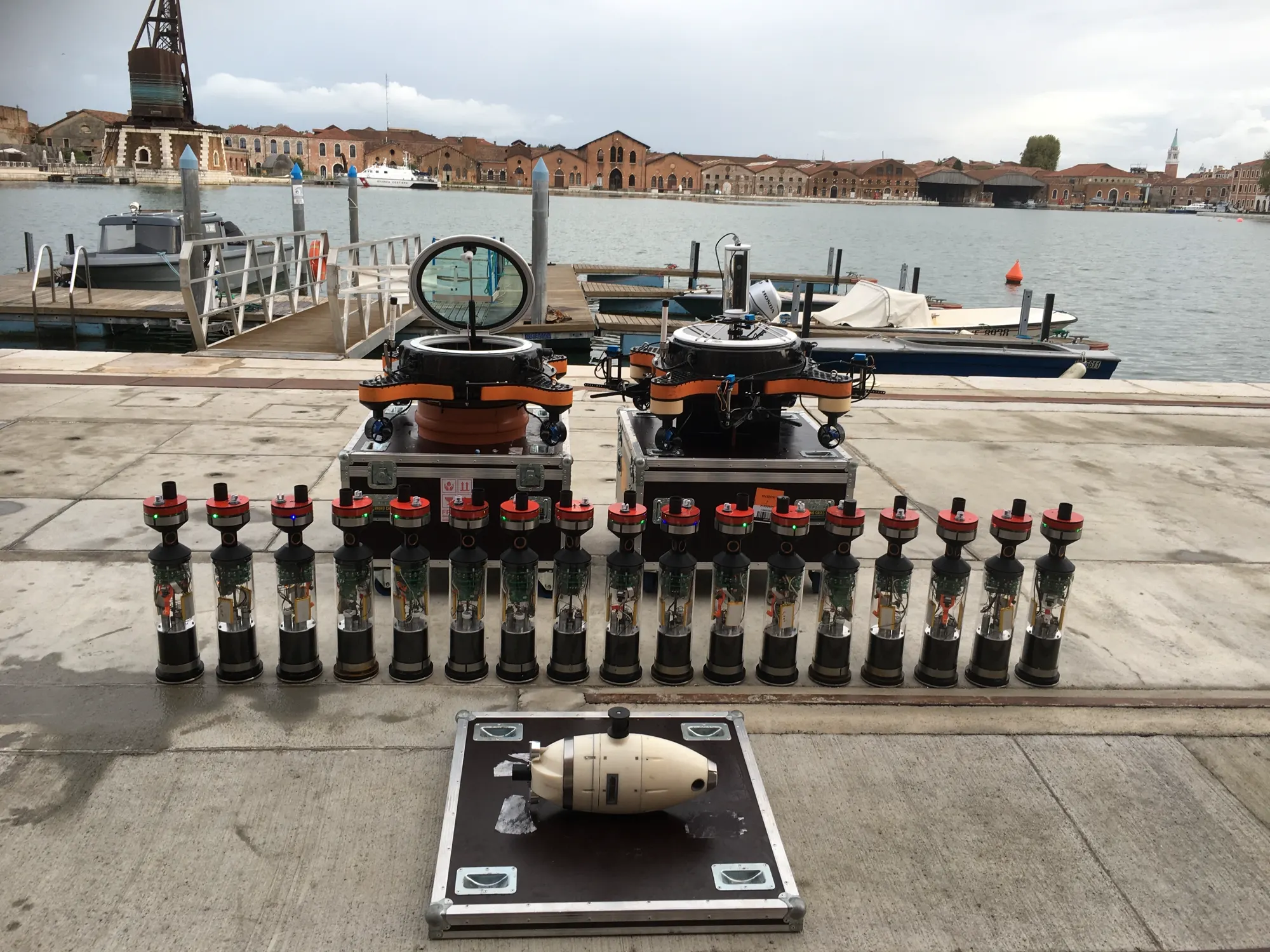
- PhD
- TU Graz, Computer Science
- 12
- Peer-reviewed papers
- Venice
- Lagoon field deployments
- 2019
- Thesis defended
The problem
Underwater is the hardest place to run a robot swarm. You lose the things terrestrial multi-robot systems quietly depend on: no GPS, no reliable high-bandwidth radio, no shared clock, and severely limited communication range. Anything that assumes a robot knows where it is, or can talk to the whole group, is off the table.
The question the lab was asking: can a group of robots that can only exchange very small messages with immediate neighbours still reach a collective decision - detect an event, agree that it happened, and act on it - with no central coordinator?
That question ran on two tracks at once, and they were the same project. One was theoretical, and became my doctoral thesis. The other was a fleet of robots in a lagoon.
One paradigm rather than a catalogue
Swarm robotics has a proliferation problem. The literature contains a long list of bio-inspired algorithms - each modelled on a different organism, each presented with its own vocabulary, each demonstrating some collective behaviour. Aggregation here, foraging there, collective decision-making somewhere else.
The thesis started from a suspicion: that many of these are not actually distinct algorithms. They are the same underlying mechanism, parameterised differently and described in the language of whichever organism inspired them.
So I developed a design paradigm intended to unify these behaviours under a single formulation built on minimalistic communication - robots exchanging very small amounts of information with immediate neighbours only. The claim being tested was that known collective behaviours could be recovered as special cases of one framework rather than requiring bespoke algorithms. It was published as A swarm design paradigm unifying swarm behaviors using minimalistic communication in Bioinspiration & Biomimetics (2020), and the doctorate was completed under Prof. Franz Wotawa and Prof. Thomas Schmickl at TU Graz.
The framework deliberately did not stop at simulation, and that is where the two tracks meet. A unification claim is only interesting if it survives contact with real robots, where the idealised assumptions behind most swarm models - reliable communication, synchronous updates, homogeneous agents - quietly fail. subCULTron supplied the robots that could falsify it.
From framework to firmware
I designed and implemented these algorithms in simulation and then ported them down to embedded C/C++ running on the physical robots - sensing, inter-robot communication and actuation modules. That full-stack path from behaviour model to firmware is where most of the interesting failures live: a rule that converges cleanly in simulation can be destroyed by a message-loss rate the simulator never modelled.
Two further results came out of this line of work: collective event detection using bio-inspired minimalistic communication (ALIFE 2019), and CIMAX, on collective information maximization using local communication (Adaptive Behavior, 2020).
Field deployment
The behaviours were validated in real deployments in the Venice lagoon - a site with genuinely adversarial conditions for this class of system: turbidity, currents, and communication characteristics that no lab tank reproduces.
Field robotics is a different discipline from lab robotics. The constraints stop being algorithmic and start being logistical: what you can debug from a boat, what you can recover if it fails, how many runs you get per day.
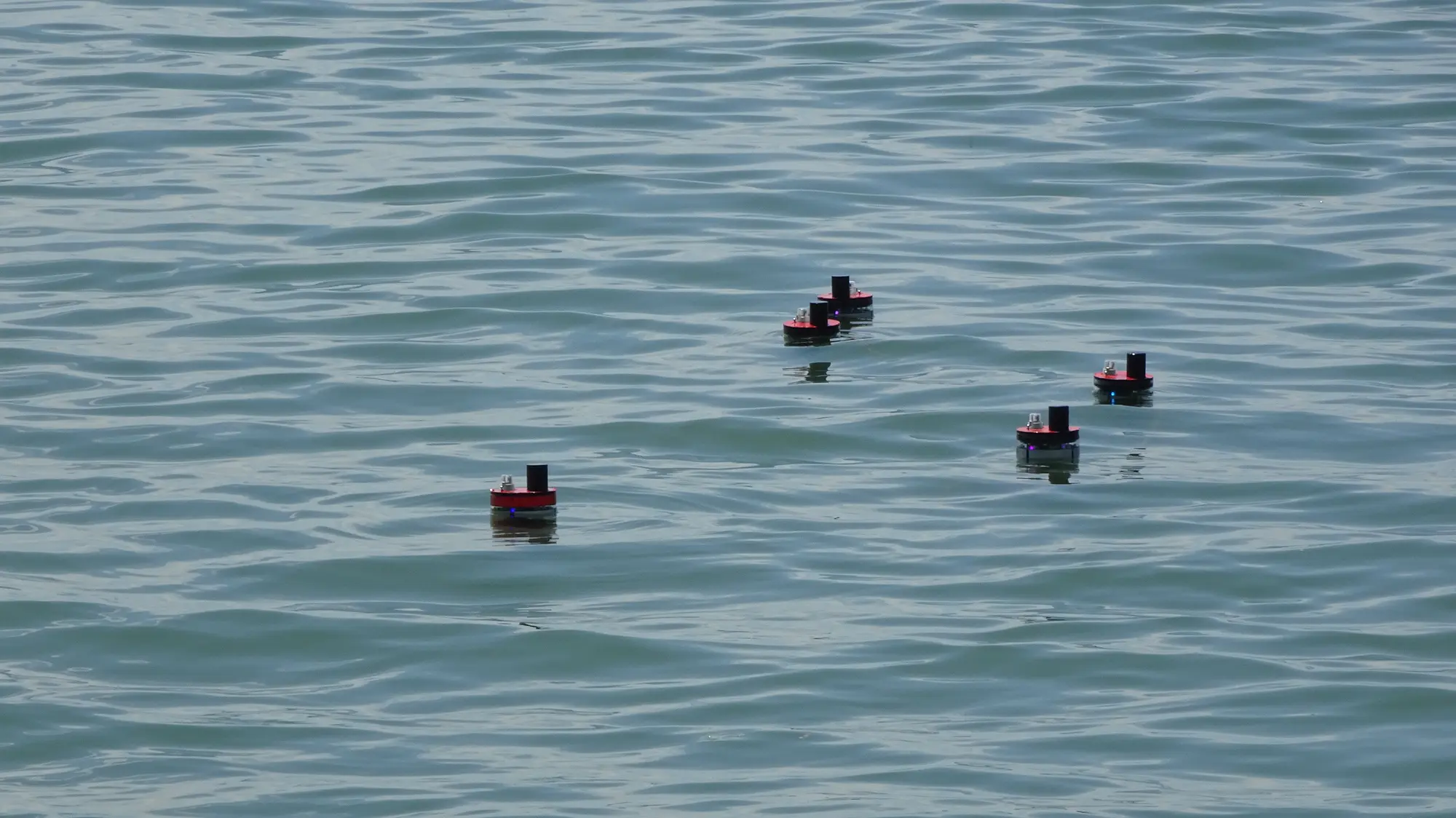
Below the surface, the conditions the text above describes stop being abstract. Visibility collapses within a couple of metres, the units drift on the current, and the water column looks the same in every direction - which is precisely why none of the coordination could depend on a robot knowing where it was.
Why it matters
Minimalistic-communication swarms are a useful stress test for a broader question in multi-robot autonomy: how much coordination can you get from how little information? The constraints that make underwater hard - partial observability, unreliable communication, no global state - are the same constraints that show up in any decentralised multi-agent system operating in the real world.
The through-line into everything I have built since is a preference for one well-chosen abstraction over many special cases. The same instinct that asked whether a dozen swarm algorithms were really one algorithm is the instinct that later shaped how I drew the localization interface on a production robot: find the boundary that makes the variations parameters rather than rewrites.